
Perplexity for Real Estate Agents:The Easiest Way to Research Properties Faster
Every agent has spent 45 minutes assembling a research brief that covered maybe 60 percent of what they needed. Perplexity compresses that into two to three minutes — with citations so you can verify everything before you use it professionally.
Last updated: May 7, 2026

Every real estate agent has been in this situation. You have a showing tomorrow in a neighborhood you don't know as well as your core market. Your buyer is going to ask about the schools, the recent development on the main road, what the market has been doing, whether there are any plans for the vacant lot two blocks away.
You know roughly what to say. But "roughly" isn't the same as prepared. So you open six browser tabs. You search the school district name. You look for local news. You try to find anything about recent construction permits. You skim three different sources, copy some notes, and spend 45 minutes assembling a research brief that covers maybe 60 percent of what you needed.
Perplexity was built for exactly this problem. It's a free AI research tool that searches the live web, answers your questions in plain language, and — most importantly — shows you exactly where every piece of information came from so you can verify it before you use it professionally.
For the complete multi-tool workflow — Perplexity, ChatGPT, Claude, NotebookLM, and Gemini working together as a system — the free AI Workflow Starter Guide at GetAI Academy is the best starting point.
Watch the full walkthrough — Perplexity for Real Estate Agents: Research Properties Faster
What Is Perplexity?
Perplexity is an AI-powered research tool available at perplexity.ai. It's free to use with a basic account, with a paid Pro option that unlocks additional features. Here is the simplest description of what it does: you ask it a question, it searches the web in real time, and it returns an answer with citations — links to the actual sources it used.
The key distinction is citations.
When you ask most AI tools a question, they generate a response from their training data. They sound confident. They may be right — they may not be. You have no easy way to know. When you ask Perplexity a question, it shows you where each piece of information came from. You can click through to the source, check the publication date, and decide whether it's reliable before you use it professionally. For licensed agents where passing unverified information creates professional liability, that citation visibility changes the quality of the tool entirely.
ChatGPT vs. Perplexity
Two different tools — two different jobs. Use both.
ChatGPT
Writer & Organizer
ChatGPT draws from its training data to draft, structure, and organize. It's exceptional at turning your context into polished, professional output.
- Drafting emails and communications
- Structuring talking points
- Preparing consultation frameworks
- Organizing information you provide
- Writing and editing content
Perplexity
Live Web Researcher
Perplexity searches the live web and returns cited results. It's designed for finding current information from external sources — with every claim linked to its source.
- Live web research with citations
- Current neighborhood intelligence
- School district updates
- Development and zoning news
- Market condition context
Both belong in a complete real estate AI workflow. Perplexity researches. ChatGPT writes. Use each for its right job.
What Perplexity Can Do for Real Estate Agents
Research a Neighborhood Before a Showing
This is the most immediate and practical use case for most buyer agents. Before any showing in a neighborhood you want to know better, Perplexity can pull current information from local news, public records, business directories, and other sources — in one query, in two to three minutes, with citations attached. You learn about development projects, recent notable sales, business openings or closures, and anything that has made the neighborhood newsworthy in the past year.
School District Research
Buyers with children ask about schools in almost every transaction. Perplexity can pull current school ratings, program information, enrollment policies, and recent coverage of changes in the district. Important: keep information focused on programs, ratings, and enrollment policies. Never describe a school in terms of the demographics of the community it serves. That framing creates Fair Housing exposure regardless of the tool used.
Market Conditions Context Before Client Conversations
Sellers walk into listing appointments with AI-generated price estimates that may not reflect current conditions. Buyers ask "is now a good time to buy?" Perplexity pulls current market condition information — inventory trends, days on market direction, price trend signals — from publicly available sources, cited and dated. This research supplements your MLS data. It does not replace it.
Development and Zoning News
One of the most common buyer regrets is discovering after closing that something significant was planned for a nearby property. Most of this information is publicly available in municipal records, planning commission minutes, and local news coverage. Perplexity finds this kind of forward-looking information in a single research query. A two-minute search before a showing can surface something a buyer genuinely needed to know.
HOA and Community Reputation Research
For properties in HOA-governed communities, Perplexity can pull publicly available information — news coverage, management company reviews, any regulatory issues that have been reported. This research supplements a formal review of the HOA's financial documents. It doesn't replace it.
Competitive Research Before a Listing Appointment
Before a listing appointment, Perplexity can pull publicly visible agent marketing content, market commentary from local real estate sites, and any visible gaps in what's available to sellers researching the market. This is preparation intelligence for your own positioning — not content to replicate, but context to understand.
Getting Started: Perplexity in Three Steps
Go to perplexity.ai and create a free account.
You do not need the paid version to use any of the workflows in this guide.
Type your research question conversationally.
Ask it exactly the way you'd ask a knowledgeable colleague. Perplexity handles conversational questions well. You don't need to use keyword-style search phrasing.
Read the answer — then look at the citations.
The numbered sources appear alongside the text. Click through to any source before you use the information professionally. A local news article from three months ago is reliable. A blog post from an SEO content farm with no byline is not. Perplexity shows you the sources. You evaluate which ones to trust.
7 Perplexity Prompts for Real Estate Agents to Try Today
Each of these is ready to copy, paste, and adapt with your specific details. Remember: Perplexity shows you citations. Check them before using any information with a client.
Professional Guardrails for Using Perplexity
Perplexity is more reliable than general AI tools for research because it cites live sources. It is not a verified database, and the responsibility for professional accuracy stays with you.
Check every citation before you act on it.
Perplexity searches the web and returns results ranked by relevance — not necessarily by authority. A municipal government website is authoritative. A real estate blog post from three years ago is not. Click through and check the source type and date before you rely on the information.
Note when information was published.
Real estate conditions change quickly. An article about market conditions from 18 months ago may describe a situation that has reversed. Perplexity shows publication dates on most citations. Look for them.
Verify market data against your MLS.
Any market data Perplexity returns comes from publicly visible sources, not your MLS. Use it for context and conversation. Use your MLS for the verified data you put in front of clients professionally.
Keep school research focused on programs, not demographics.
School questions from buyers should be answered with information about programs, ratings, and enrollment policies — not descriptions of the demographic characteristics of the school community. This applies regardless of where the information came from.
Perplexity is a starting point, not a conclusion.
It surfaces information and shows you where to look. Your professional judgment evaluates that information and decides what to act on and what to verify further.
Human review is the compliance layer.
In a supervised, licensed profession, broker oversight and professional review requirements don't change because an AI tool helped you gather information. Your workflow should be one your broker can review and approve.
Visual Summary: The 7-Point Research Workflow & Guardrails
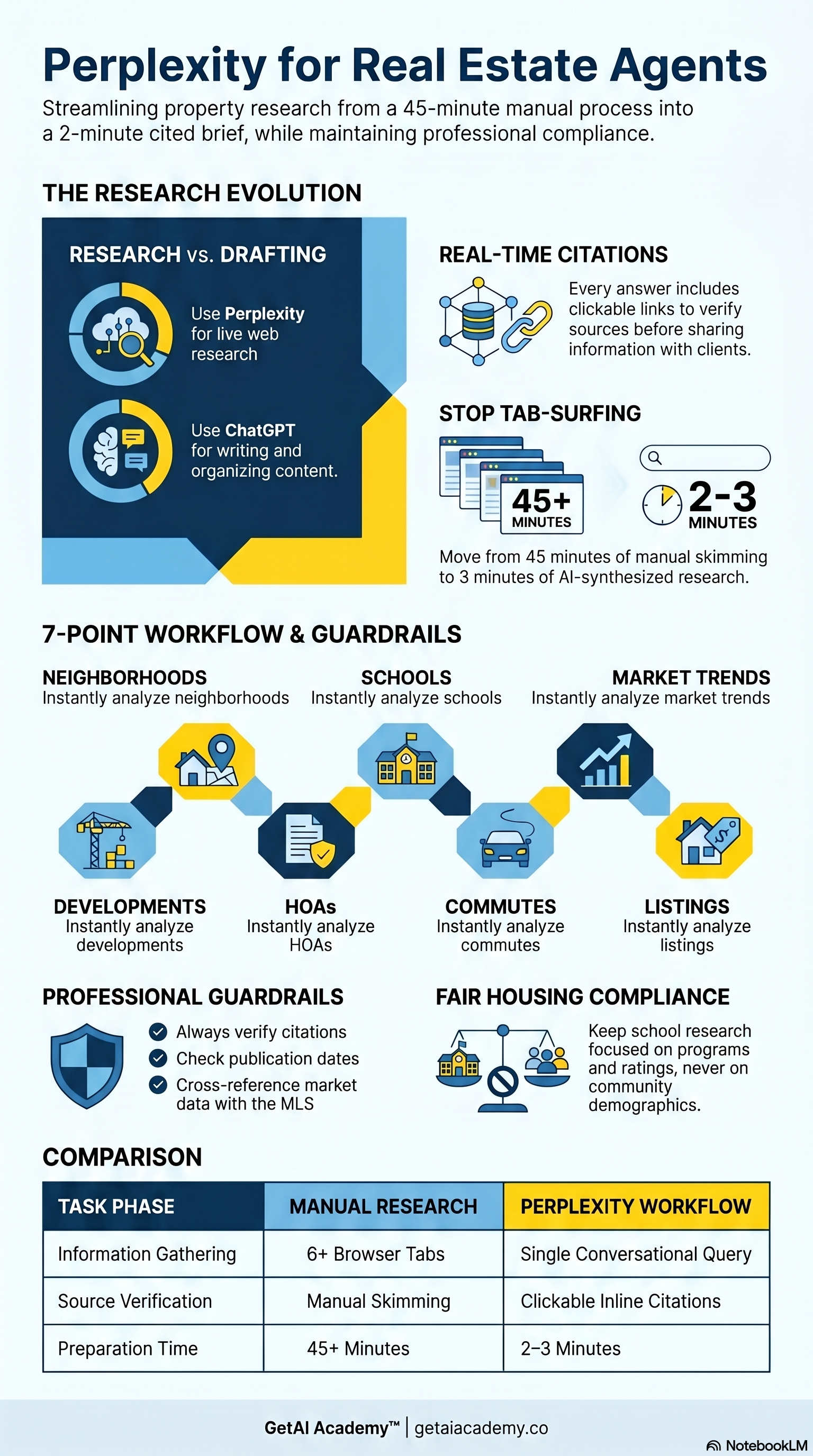
Share this infographic with your team or use it in broker training sessions.
What Perplexity Helps Real Estate Agents Research
Perplexity compresses multi-tab research into one structured workflow with visible citations.
| Research Area | What Perplexity Can Surface | Why It Matters |
|---|---|---|
| Neighborhood Research | Development projects, local news, infrastructure changes, business openings | Helps agents prepare for buyer questions before showings |
| School Districts | Ratings, programs, enrollment changes, district updates | Supports informed client education conversations |
| Market Conditions | Inventory trends, pricing direction, days on market signals | Adds context before pricing and buyer consultations |
| Development & Zoning | Pending projects, permits, municipal planning decisions | Helps uncover future changes near a property |
| HOA Research | Public litigation, management reviews, reported issues | Supports deeper HOA due diligence preparation |
| Commute Research | Traffic patterns, transit options, route timing | Improves buyer lifestyle conversations |
GetAI Academy™ Note: Perplexity should support research and preparation — not replace MLS verification, broker oversight, or professional judgment.
Slide Deck: Perplexity Real Estate AI Research Blueprint
The Next Step
Perplexity is one tool in a system that also includes ChatGPT for drafting, Claude for document analysis, NotebookLM for your personal knowledge base, and Gemini for Google Workspace integration. Each tool has a specific role. Using the right one for the right task is what produces consistent, reliable results.
The free AI Workflow Starter Guide at GetAI Academy maps the complete system — which tool for which task, in a format built specifically for licensed real estate professionals.
Frequently Asked Questions
Professional Review Notice
This content is intended as a general educational resource for licensed real estate professionals. AI-assisted outputs — including listing descriptions, client communications, marketing content, research summaries, and workflow drafts — should be reviewed for accuracy, Fair Housing awareness, MLS advertising requirements, brokerage policy, and broker approval before professional or public use. GetAI Academy does not provide legal, compliance, or brokerage-specific advice. Always verify AI workflows with your broker of record and applicable state real estate commission guidelines. Compliance Guidelines →Want a safer starting point for AI in your practice?
The AI Workflow Starter Guide covers which tools to use, which tasks each one handles, and how to structure a review process your broker can approve. Free for licensed real estate professionals.

About the Author
John Palmer
Founder, GetAI Academy
John Palmer helps licensed real estate professionals understand and implement AI through broker-reviewable workflows, Fair Housing-aware content practices, and practical training systems designed for regulated, broker-supervised environments.
About the Founder →Continue Reading

ChatGPT for Real Estate Agents: What It Actually Does
The complete beginner guide to ChatGPT for licensed agents — what it can do, what it cannot, and seven prompts to start with today.
AI Basics for Agents: The 90-Minute Structured Session
A structured 90-minute session covering setup, workflows, compliance, and the complete multi-tool framework for buyer and listing agents.
The Beginner's Guide to Using AI as a Realtor
A simple, jargon-free guide for real estate agents who want to use AI safely, even if you have zero tech experience.